
Who we are
Collective Intelligence unites four independent organisations whose expertise spans AI research, school improvement, curriculum and assessment, and digital equity. Each brings distinct expertise; all share the conviction that AI in education must be shaped by those who understand learning, not just technology.
Educate Ventures Research | Good Future Foundation | Oasis Big Education Institute | Cambridge University Press & Assessment




Collective Intelligence is an education consortium for the AI era. It brings together independent organisations that share a commitment to evidence, equity, and educator empowerment. We pool our expertise in research, professional development, curriculum, assessment, and policy to help schools, colleges, and universities navigate AI wisely — so that technology serves learners and communities, not the other way around.

Professor Rose Luckin, Founder and CEO, Educate Ventures Research, introduces Collective Intelligence
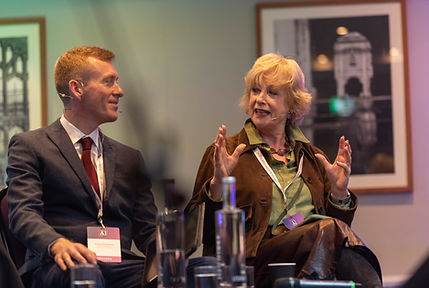
The Collective Intelligence team at the Cambridge AI Summit; photos courtesy of Cambridge University Press & Assessment, 2026
[OO]
Events and Appearances
Collective Intelligence launched at the Cambridge AI Summit on 16th October 2026.
There, the founding partners explored what becomes possible when human expertise is pooled in response to the pace and complexity of AI. Bringing together perspectives from research, professional development, assessment, and school improvement, the panel examined what educators genuinely need right now, what the evidence tells us about AI in schools, and why a collective response — grounded in practice rather than hype — is essential for education systems navigating an uncertain landscape. The conversation drew on findings from the new Human Intelligence First: the Tool is the Smallest Part report and asked a defining question for the consortium: what can we achieve together that none of us can achieve alone?

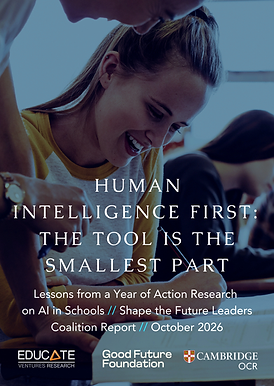
Evidence for the value of AI for education is crucial. Educate Ventures Research, Good Future Foundation, and Cambridge OCR, have now released a new research report at the launch of Collective Intelligence under the Shape the Future Leaders Coalition. 'Human Intelligence First: the Tool is the Smallest Part' consists of findings from nine practitioner-led action research projects performed by school leaders from across England's schools over the last year. The research projects were designed to create the conditions for school leaders to become generators of their own evidence rather than simply being consumers of it. The report is available to download here.
Professor Rose Luckin, Founder and CEO, Educate Ventures Research, introduces the Human Intelligence First report
Collective Intelligence will be present wherever the future of AI in education is being shaped. We are committed to bringing our combined expertise into the rooms, conferences, and national conversations where decisions about teaching and learning get made — ensuring that the educator and student voice is heard, and that evidence, not hype, drives what happens next in our schools and colleges.
[OO]
Opportunities
The Collective Intelligence partners are active across research, professional development, curriculum, assessment, and school improvement. Explore current opportunities in the menu above, or find out more under the Opportunity Spotlight below, and find out how you can engage with the work of the consortium directly.
***
The Big AI Project — free headteacher training
-
Price: Free
-
Dates: Multiple dates available
-
Times: Multiple slots available
-
Location: Regional venues across the UK and Republic of Ireland
-
Spaces: Limited to one per school
-
Contact for more information: alison.gellett@oasisuk.org
Big Education's national Big AI Project has one aim: to equip every school in the UK and Republic of Ireland with the skills needed to approach an AI-infused world safely, ethically, and strategically. Headteachers who attend the free face-to-face training will receive a full suite of online teacher training resources, school leader materials, and AI literacy curricula for ages 3–14 — all educator-designed, quality-assured by Professor Rose Luckin's Educate Ventures Research, and piloted with over 230 schools. Book your place here.
***
AI Quality Mark - a clear pathway to strategic and responsible AI implementation
Designed by school leaders, verified by AI engineers, and reviewed by educators, Good Future Foundation offers the AI Quality Mark to provide schools a clear pathway to strategic and responsible AI implementation.
Good Future Foundation's supportive process begins with an initial conversation with their team to understand your school's unique context and needs. You'll then have the opportunity to self-assess against the GFF framework at your own pace. Assessors will then review and moderate the rating, followed by a feedback session where the team will discuss tailored support and guidance for your next steps.
More than 3,000 schools have joined Good Future Foundation on the AI Quality Mark path, each moving at their own pace. Please reach out to the team at quality-mark@goodfuture.foundation if you would like to learn more.
In-person Professional Development
Good Future Foundation guide teachers through key areas around responsible AI use in education settings, from understanding the basics and using it to streamline your work, to keeping students safe and integrating it to enhance teaching and learning. GFF are tech agnostic and will meet schools where they are at in tailoring content to ensure it addresses the identified gaps. Watch this video to learn more about their approach and email the GFF team at info@goodfuture.foundation to learn more.
[OO]
Resources
AI and Your Child's Learning - A Guide for Parents
AI tools like ChatGPT can answer questions and write things. But AI does not actually understand anything. It puts words together based on patterns. It can be very wrong, and it sounds confident even when it is. AI is also now built into many apps and social media that children use every day. This includes the feeds on TikTok, YouTube and Instagram, which use what your child watches to decide what to
show next.
When children use AI to do their thinking for them, they miss the practice that builds real skills. This matters just as much as getting the right answer. It is important to get the right balance: AI should support your child’s learning, not replace it.
Here you will find two documents explaining what parents need to know about their child's interactions with AI. One is a full guide and the other a one-page primer. Both have been written for the Collective Intelligence consortium by Professor Rose Luckin, Founder and CEO of Educate Ventures Research, based on her 30 years of experience in the field, and current research into AI for education.


[OO]